
Level : Intermediate
How much energy does AI use? The official figures, without the hype
By The Info Agent IA editorial team ·

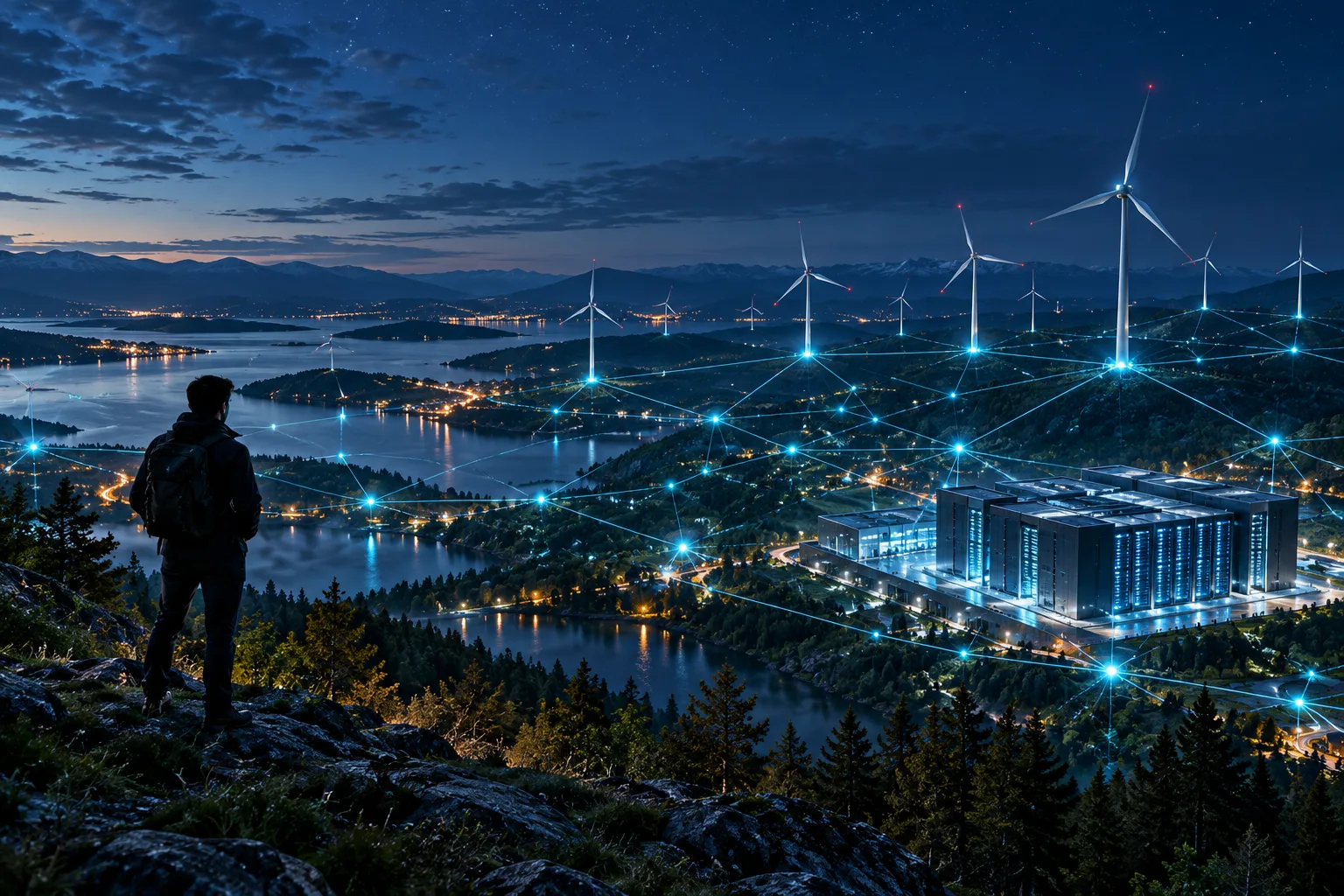
AI uses electricity mainly inside data centers, which according to the International Energy Agency account for about 1.5% of global electricity consumption, a share expected to double by 2030 largely because of AI. For a single chatbot question, the official estimates available are small, around 0.3 watt-hours, but they remain partial, unverified and highly dependent on how you use the tool.
Why AI needs electricity
An AI model like the ones behind ChatGPT, Gemini or Claude runs on thousands of graphics processors (GPUs) housed in data centers. These chips draw power to compute, and the buildings draw more power to keep them cool.
There are two distinct phases:
- Training. The model learns from huge amounts of text over weeks or months. It is a one-off but massive effort, measured as training compute.
- Use, known as inference. Every time you ask a question, the model writes its answer token by token. A single request costs little, but there are billions of them every day.
Measuring all this is harder than it sounds. A data center serves many customers at once, chips sit idle part of the time, and cooling, networking and backup systems all add to the total. That is why two honest estimates for the same task can differ widely, depending on what each one chooses to count.
To see who builds this infrastructure, our cornerstone guide who makes AI? maps the main AI companies.
The global picture: data centers
The reference source is the International Energy Agency’s (IEA) “Energy and AI” report. The agency’s website could not be opened directly while this article was being written, so we quote its figures as reported on the European Commission’s page on the energy performance of data centres, accessed on October 22, 2026.
One terawatt-hour (TWh) is a billion kilowatt-hours. Two clarifications help avoid misreadings. First, those 415 TWh cover all data centers, not just AI: cloud storage, streaming, websites and business software run there too. Second, 1.5% is still a modest slice of global demand, but growth is fast and highly concentrated in certain regions, which puts real pressure on local power grids.
The United States and Europe
The United States hosts a large share of AI data centers. A report by Lawrence Berkeley National Laboratory, released by the US Department of Energy on December 20, 2024 (accessed on October 22, 2026), found that data centers used about 4.4% of US electricity in 2023, or 176 TWh, up from 58 TWh in 2014. It projects 6.7% to 12% by 2028, meaning 325 to 580 TWh. The gap between those two bounds tells you how uncertain the outlook is.
In Europe, the Commission proposed a common rating scheme for data centres on September 21, 2026 (accessed on October 22, 2026). Citing the IEA, it notes that data centers are projected to use more than 3% of EU electricity by 2030. Facilities above 500 kW of capacity will publish information on their energy and water use, with the first labels expected in 2027. At the same time, the EU wants to triple its data center capacity within five to seven years, a sovereignty question we cover in European AI versus the US and China.
| Indicator | Value | Source (accessed October 22, 2026) |
|---|---|---|
| Data centers, worldwide | about 415 TWh, 1.5% of electricity | IEA, quoted by the European Commission |
| Global projection for 2030 | towards 945 TWh | IEA, quoted by the European Commission |
| Data centers, United States 2023 | 176 TWh, 4.4% of electricity | LBNL, US Department of Energy |
| US projection for 2028 | 325 to 580 TWh, 6.7% to 12% | LBNL, US Department of Energy |
| European Union projection for 2030 | more than 3% of electricity | IEA, quoted by the European Commission |
What about a single chatbot question?
This is what most people want to know, and it is where the data is weakest. A few companies and researchers have published per-request estimates:
| Estimate | Published figure | Source |
|---|---|---|
| Median Gemini text prompt (May 2025) | 0.24 Wh, 0.03 g CO2 equivalent, 0.26 mL of water | |
| Typical GPT-4o query | about 0.3 Wh, range 0.1 to 4 Wh | Epoch AI |
| Average ChatGPT query | about 0.34 Wh | Sam Altman, OpenAI CEO |
| 400-token answer in Le Chat | 1.14 g CO2 equivalent, 45 mL of water | Mistral AI |
In its August 21, 2025 post, Google compares its 0.24 Wh to less than nine seconds of watching TV and says it cut energy per prompt 33-fold between May 2024 and May 2025. Google states that these figures have not been verified by an independent third party. The research group Epoch AI published an estimate for GPT-4o on February 7, 2025: around 0.3 Wh, ten times lower than the often-quoted 3 Wh, while stressing substantial uncertainty. Sam Altman gives about 0.34 Wh in a post on his personal blog, without a detailed method.
Mistral AI took a different route: a life cycle analysis of Mistral Large 2, published on July 22, 2025 with the consultancy Carbone 4 and the French environment agency ADEME. It includes server manufacturing, which explains the higher numbers. In total, after 18 months of use, the model had generated 20.4 kilotonnes of CO2 equivalent and consumed 281,000 m³ of water. Mistral itself calls it “a first approximation”. All these pages were accessed on October 22, 2026.
What makes consumption go up or down
Not all requests are equal. Several factors push the energy bill up:
- Context length. According to Epoch AI, a query with 10,000 input tokens would use about 2.5 Wh, and around 40 Wh with 100,000 tokens. Pasting a long report into your context window has a real cost.
- Reasoning. A reasoning model generates many intermediate tokens before answering, so it uses more energy.
- Model size. A small language model needs far less computation than a frontier model. Open-weight models, which we compare in open-source versus proprietary AI, can also run on local hardware.
- Content type. Images, voice and video take more computation than text.
- The electricity itself. For the same consumption, emissions depend on the power mix feeding the data center.
You can check how long your requests are with our token estimator.
Check yourself Which uses more energy: a short question to a light model, or a reasoning model analyzing an 80-page report?
The long report, by far. It combines a very long context with a model that generates many intermediate tokens. Based on Epoch AI’s estimates, a long context can multiply the energy of a single request by more than ten.
Neither doom nor denial
Transparency is improving slowly. Most figures come from the companies themselves, using different methods, which echoes the limits of AI benchmarks: a number means little without its method. The EU data center rating scheme could provide more consistent data from 2027. For other key indicators, see our AI in numbers page.
Frequently asked questions
Does asking ChatGPT or Gemini a question use a lot of electricity?
For a short text prompt, published estimates sit around 0.3 watt-hours, which Google compares to a few seconds of watching TV. The figure rises sharply with long documents, reasoning models, images and video. These are estimates from AI companies or researchers, not measurements checked by an independent body.
What share of the world's electricity do data centers use?
According to the International Energy Agency, as quoted by the European Commission, about 1.5% of global electricity, or 415 TWh a year. The agency projects this to more than double to around 945 TWh by 2030, driven mainly by AI computing. Data centers also run cloud storage, video streaming and websites, not just AI.
Which uses more energy: training a model or using it?
Training a large model is a concentrated spike of consumption over weeks or months. Everyday use, called inference, costs little per request but is repeated billions of times. AI companies do not routinely publish a split between the two, so there is no reliable general answer.
How can I reduce the footprint of my own AI use?
Pick a lighter model for simple tasks, avoid pasting the same long document into every message and group your requests. Keep deep reasoning modes and video generation for cases where they really help. Mistral AI makes similar recommendations in its published life cycle analysis.