
Level : Beginner
AI voice cloning scams: how to protect your family
By The Info Agent IA editorial team ·

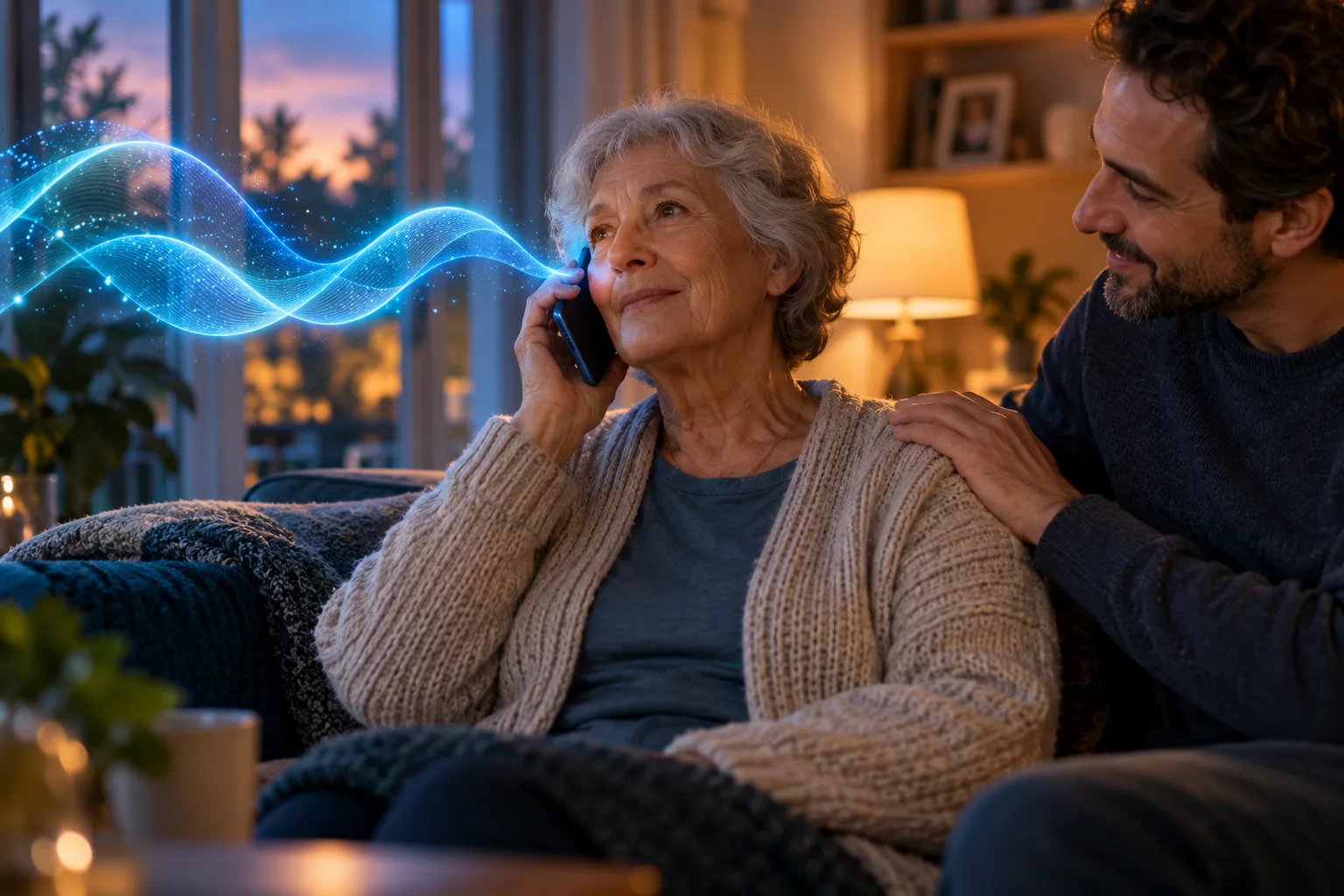
An AI voice cloning scam is a phone call that uses a voice imitating someone you love to demand money urgently. In most cases two habits are enough to protect you: hang up and call the person back on a number you already know, and agree on a family safe word today.
How a voice cloning scam works
The script hardly ever changes. Your phone rings. You hear your son, your granddaughter or your partner, panicking: a car crash, an arrest, a phone stolen abroad. They need money right now, and they beg you not to tell anyone. Sometimes a second person takes over, claiming to be a lawyer, a police officer or a doctor.
What is new is the voice. Speech synthesis, the technology that turns text into spoken words, can now imitate a specific voice from recordings. Those clips may come from a video on social media or a voicemail greeting. The result is an audio deepfake: a fake recording that makes it sound as if a real person said something they never said.
We will not explain how these voices are produced. What matters for you is simple: a voice on its own no longer proves anything. The rest of the scam relies on very old tricks: urgency, emotion and secrecy. These schemes belong to a wider family described in our guide to AI scams and how to protect yourself.
The warning signs
A perfectly imitated voice can fool anyone. The scammer’s script, however, nearly always leaves the same traces. If several of these signs show up in one call, stop.
| Warning sign | What you hear | What to do |
|---|---|---|
| Extreme urgency | “You have to pay now, or else…” | Slow down: a real emergency can survive five minutes of checking |
| A demand for secrecy | “Don’t tell Dad”, “don’t call anyone” | Tell another relative, precisely because you were asked not to |
| Unusual payment | Gift cards, crypto, a transfer to a new account | Refuse to pay anything during the call |
| Unknown number | “I lost my phone, I’m calling from a friend’s” | Call back on their usual number |
| A pushy go-between | A fake lawyer or officer comes on the line | Contact the organization yourself using its official details |
| Vague answers | The caller dodges specific questions | Ask something only the real person would know |
Secrecy is the biggest giveaway. A relative who is genuinely in trouble has no reason to stop you from calling the rest of the family. The scammer has an excellent reason: one phone call would bring the story down.
Setting up a family safe word
A family safe word is the simplest and most effective protection. It is a word or short phrase known only to your close family, which you ask for when a call worries you. Here is how to set one up.
- Choose it together, face to face. Not by text, not in a group chat. A family dinner is perfect.
- Make it impossible to guess. Skip the dog’s name, your hometown or a birthday, which may be on social media. A random phrase such as “orange umbrella” works better.
- Never write it down online. Not in an email, a shared note or a conversation with an AI assistant.
- Explain the rule to everyone. If someone calls asking for money in an emergency and cannot give the safe word, you hang up and check. No exceptions, however convincing the voice.
- Practice it now and then, especially with grandparents and children. A forgotten safe word protects nobody.
If you have not set one up yet, a personal question can help in the meantime: “What did we have for dinner at my place last Sunday?” Pick a recent detail that appears on no social network.
Hang up and call back on a known number
This habit defeats more scams than any other, with or without AI. It works because the scammer controls the call they make, but not the call you make.
- Hang up politely, even if the voice is crying. Just say you will call right back.
- Dial the person’s usual number yourself, the one saved in your contacts. Never use a number given to you during the call.
- If they do not answer, call someone else close to them: a partner, a sibling, a roommate. In the vast majority of cases you will learn they are fine.
- For a fake organization (bank, police, hospital), look up the number yourself on the official website or on a document you already have.
Do not be reassured by caller ID showing a relative’s or a bank’s name: caller ID can be spoofed. Only the call you place yourself can be trusted.
Check yourself Your grandson calls in tears from an unknown number: he had a car accident and must pay bail in gift cards, without telling his parents. What do you do?
You hang up without paying anything, then call your grandson on his usual number. If he does not answer, you call his parents, despite the request for secrecy. Three warning signs are present: an unknown number, a demand for secrecy and payment in gift cards. If you had agreed on a family safe word, you could also have asked for it.
Protecting those most at risk: older parents and children
Older people are frequent targets because they tend to pick up the phone and want to help their grandchildren. Take the time to walk them through the scam with a concrete example, without frightening them. Keep a list of family numbers to call back next to their phone.
Children and teenagers are affected in a different way: their voices travel through the videos they post. Talk it over with them and review the visibility of their accounts together. Our guide to kids and AI offers practical pointers.
More broadly, limit what is public: long videos where you can be heard speaking, but also the details that make the story believable, such as your current travels or the names of your relatives. Our pillar article on AI and privacy explains what happens to the data you share.
If the call has already happened
If you have paid or shared information, act quickly and without shame: these scams fool very careful people.
- Call your bank or payment provider immediately to try to stop or recover the payment. If you bought gift cards, contact the card company too.
- Keep the evidence: the calling number, time, duration, messages, gift card receipts.
- Report it. In the United States, the FTC collects reports at ReportFraud.ftc.gov. In the United Kingdom and elsewhere, use the official fraud reporting service of your national police.
- Warn your family, as scammers sometimes call back with a new story.
To learn more about false information produced by AI, read our guide on how to fact-check an AI answer.
Learn more
If some terms in this article feel unfamiliar, our AI glossary explains them in plain words, including the entry on AI-powered scams.
Frequently asked questions
Can a scammer really copy a loved one's voice?
Yes. Speech synthesis tools can reproduce a voice from existing recordings, such as a video posted online. A familiar voice on the phone is no longer proof of who is calling.
What is a family safe word?
It is a word or short phrase agreed in advance with your family, known only to them and never posted anywhere. If you get an urgent, worrying call, you ask for it. If the caller does not know it, hang up and check another way.
What should I do if I have already sent money?
Contact your bank or payment provider right away to try to stop or recover the payment. Keep the evidence, such as the number, the time of the call and any messages. In the United States you can then report the scam to the FTC at ReportFraud.ftc.gov.
Should I delete every video where people can hear my voice?
Not necessarily. Posting less in public reduces exposure, but the real protection is the habit of checking. Even if a scammer gets a sample of your voice, a call back on a known number or a family safe word is enough to stop the scam.